
Go Back
Regulatory Compliance in Construction: A Crew Documentation Guide
Discover how to fix inconsistent crew documentation and strengthen regulatory compliance in construction with a repeatable capture standard for traffic manag...


How Australian traffic management leaders can replace ad-hoc crew records with a repeatable capture standard
Inconsistent crew documentation is a system risk, not a people problem. This guide helps Australian traffic management leaders find gaps and build a capture standard every crew can follow.
TL;DR
Inconsistent documentation is a system problem, not a crew problem - When every crew documents differently, the issue is ambiguous expectations, not poor performance. Fix the system, not the people.
Define a minimum capture standard on one page - Specify exactly what crews record, when they record it, and in what format. If it can't fit on a laminated card, it's too complex for the field.
Embed the standard into daily workflow, don't bolt it on - Align capture points with natural shift breaks (toolbox talks, post-setup checks, pack-down) so documentation takes less than two minutes per point.
Pilot before you roll out - Test with two to three crews for two to four weeks. Refine based on real field feedback. A standard that crew reality shapes is dramatically more durable than one someone designs in an office.
Standardisation is ongoing, not a one-time project - Without quarterly reviews and sustained enforcement, documentation drift returns. Treat your capture standard as a living document that evolves with regulations, operations, and crew feedback.
Guide Orientation: What This Covers and Who It's For
This guide addresses a specific, high-stakes problem: inconsistent safety documentation across crews in Australian traffic management operations, and the compliance exposure it creates. If you lead operations for a traffic management company and every crew documents differently (different formats, different detail levels, different habits), no single audit gives you a reliable picture. That's not a crew behaviour problem. It's a system problem.
By the end of this guide, you'll understand why inconsistency persists, how to diagnose it in your own operation, and how to build a repeatable capture standard that every crew can follow without slowing down. We focus on regulatory compliance in construction and traffic management specifically, not general project management or BIM workflows.
This is not a technology buyer's guide. It's a framework for standardisation that works whether your crews use paper, phones, or dedicated platforms. Technology may help, but the system comes first.
Why Consistent Safety Documentation Matters Now
Australian traffic management faces growing regulatory pressure. State road authorities, councils, and principal contractors now demand stronger evidence that Traffic Management Plans (TMPs) and Traffic Guidance Schemes (TGSs) were actually set up on site. When crews document differently, the operation looks disjointed to auditors. Disjointed operations attract deeper scrutiny.
The cost of inconsistency is real. One crew records sign placements with timestamped photos. Another scribbles notes on a clipboard. Same company, two different evidence standards. And when an incident happens, the crew with weaker records drags the whole business into risk. Construction compliance spans safety, labour, environmental, permits, and contracts, meaning a single documentation gap can cascade across multiple regulatory domains.
Globally, the pressure is intensifying. Compliance requirements can shift quickly, as demonstrated by recent build law reforms in Australia that among other changes, expanded regulator enforcement powers in NSW. Australian operators also face state-level WHS reforms, updated Austroads guidance, and principal contractor audit programs. All of these change faster than most crews can keep up.
The operations leader who waits for an audit failure or incident investigation to reveal these gaps is already behind. But the one who builds a repeatable documentation standard before the pressure hits is the one who controls the narrative.
Core Concepts: Understanding Why Crews Document Differently
The Documentation Drift Problem
Documentation drift happens when crews build their own recording habits because no clear standard exists. Crew A takes photos before and after setup. Crew B fills in a paper checklist at the end of the shift. Crew C does both, but stores everything on a personal phone. None of them are wrong in isolation. But collectively, they make it impossible to compare, audit, or defend the company's compliance posture.
Laziness doesn't cause drift. Ambiguity does. When the instruction is "document the site," every experienced crew leader will interpret that through their own lens of what "good enough" looks like.
System Problem vs. Behaviour Problem
Most operations leaders initially frame inconsistent documentation as a training issue: "We need to tell crews to do it properly." But if five crews all document differently after receiving the same verbal instruction, the problem is the instruction, not the people. A system problem needs a system fix: standard templates, defined capture steps, and clear success criteria. From there, remove the guesswork. Remove the guesswork.
What "Standardised" Actually Means
Standardisation does not mean rigidity. Every crew captures the same minimum evidence, in the same format, at the same points. Beyond that, crews can add context. The standard sets the floor, not the ceiling. After all, crews resist standardisation when it feels like red tape. When they see it as a shared baseline that protects them personally, they adopt it.
The Audit Truth Gap
When documentation varies, audits become unreliable. An auditor checks Crew A's records and sees solid compliance. Crew B's records show gaps. Did Crew B actually fail, or just fail to record what they did? That ambiguity is the audit truth gap. It's where regulatory risk builds up. The construction industry's compliance burden covers contracts, financial reporting, permits, and licensing, making standardised forms and templates critical for defensible audits across every domain.
The Standardisation Framework: Four Phases
Eliminating inconsistent documentation is a four-phase process. Each phase builds on the previous one, and skipping phases is the most common reason standardisation efforts fail.
Phase 1: Audit the Current State — Map what every crew actually does today, without judgment.
Phase 2: Define the Capture Standard — Specify exactly what crews record, when they record it, and in what format.
Phase 3: Build the Workflow — Embed the standard into daily crew routines so compliance is the path of least resistance.
Phase 4: Verify and Iterate — Monitor adherence, close gaps, and refine the standard based on real-world feedback.
These phases are sequential for initial implementation but cyclical over time. As regulations evolve and operations change, you'll revisit Phases 2 through 4 regularly. The framework treats documentation as a living system, not a one-time fix.
Step-by-Step Breakdown: Building a Repeatable Capture Standard
Step 1: Audit What Every Crew Actually Does
Objective: Build a complete, honest picture of current documentation practices across all crews without filtering for what "should" be happening.
Start by collecting actual documentation outputs from every crew over the past 30 to 60 days. Pull checklists, photos, videos, written notes, digital submissions, whatever exists. Don't ask crew leaders to describe their process; look at what they produced. The gap between what people say they do and what they actually do is where your risk lives.
Organise the collected evidence by crew and look for patterns. Which crews capture pre-start conditions? Which ones record sign placements? Who documents deviations from the TGS? Who records nothing beyond the mandatory paperwork? Create a simple matrix: crews on one axis, documentation elements on the other. Mark each cell as "consistent," "inconsistent," or "absent."
This audit is not a performance review. Frame it explicitly as a system diagnostic. If crew leaders feel they're being evaluated, they'll either inflate their practices or become defensive, and you'll lose the honest data you need. The goal is to identify where the system fails to specify expectations, not where individuals fail to meet them.
Anti-patterns: Relying on crew leader self-reports. Auditing only your best or worst crew. Treating the audit as a one-day exercise rather than a sustained data collection period.
Success indicators: You can describe, with evidence, exactly how each crew documents. You can identify the three to five most common inconsistencies. Crew leaders understand the audit is about the system, not about blame.
Step 2: Define Your Minimum Capture Standard
Objective: Create a written specification that defines exactly what crews record, at which points in the shift, in what format, and who records it.
Using the audit findings, identify the documentation elements that are non-negotiable for regulatory compliance and contractual defence. In Australian traffic management, this typically includes: pre-start site meetings, TGS implementation evidence, any deviations or modifications during the shift, incident or near-miss records, and end-of-shift site status. Your specific requirements will vary based on state regulations, principal contractor expectations, and the types of work your crews perform.
For each element, spell out the format. "Take a photo" is not a standard. "Capture a wide-angle photo of each sign showing the sign face, its position relative to the lane, and the traffic around it" is a standard. The more specific you are, the less room for guesswork. Where you require visual evidence, define what must be visible in the frame. Where you need written records, use standardised templates with fixed fields rather than blank forms.
Consider where video documentation adds value over static photos. A drive-through recording of a completed setup, for example, captures spatial relationships and sequencing that photos cannot. Site Video Logs (SVLs) are emerging as a structured methodology for exactly this kind of standardised visual capture in traffic management.
Anti-patterns: Making the standard so comprehensive that it takes 30 minutes to complete. Defining the standard in isolation without input from experienced crew leaders. Failing to distinguish between "must capture" and "nice to capture."
Success indicators: The capture standard fits on a single page. Any crew leader can read it and know exactly what's expected without asking clarifying questions. It aligns with your regulatory obligations and principal contractor requirements.
Step 3: Embed the Standard into Daily Workflows
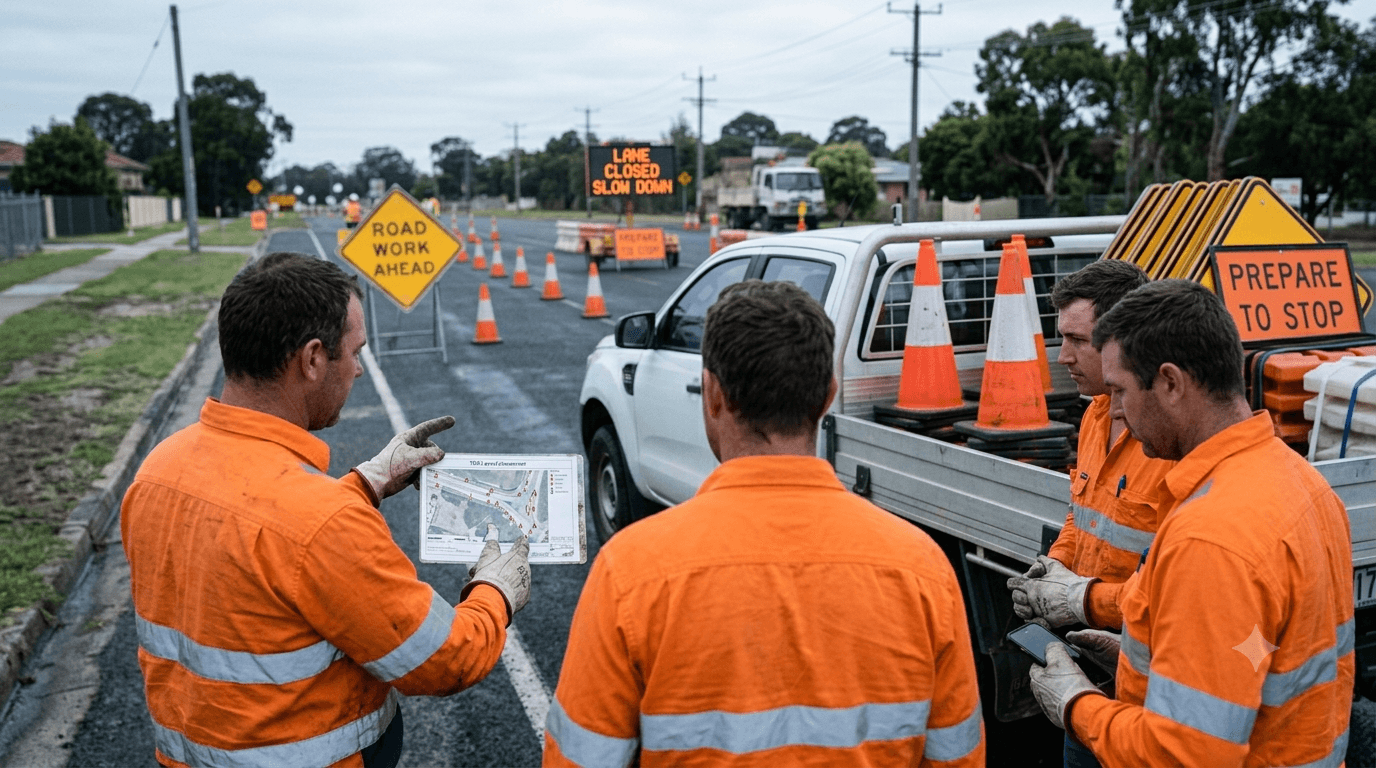
Objective: Make following the capture standard easier than not following it, so compliance becomes the default crew behaviour rather than an extra task.
The most common failure point in standardisation is the gap between "we have a standard" and "crews actually follow it." This gap exists because the standard arrives as a memo or training session, then competes with every other demand on a crew leader during a live shift. Instead, the standard must live inside the workflow itself.
Map the capture points to natural breaks in the crew's shift. Pre-start documentation happens during the toolbox talk. Setup documentation happens immediately after the crew implements the TGS, before traffic is released. Deviation documentation happens at the moment of change. End-of-shift documentation happens during pack-down. Each capture point should take under two minutes. If it takes longer, the standard is too complex for the field.
At this point, tooling matters. A crew leader fumbling with a clipboard, a camera app, and a separate reporting system will cut corners. A single-tap capture tool that timestamps, geolocates, and organises evidence automatically removes friction. SiteStory was built for exactly this scenario: simplifying field documentation into a workflow that crews actually complete because it's faster than the alternative.
From there, train crews on the workflow, not just the standard. Walk through a full shift and demonstrate exactly when and how each capture point fits. Pair new workflows with existing habits rather than replacing them entirely. If a crew already does a drive-through check after setup, add the documentation step to that existing behaviour rather than creating a separate documentation pass.
Anti-patterns: Distributing the standard as a PDF and assuming adoption. Creating documentation steps that interrupt critical safety tasks. Requiring crews to use multiple tools or apps for a single capture point.
Success indicators: Crews complete documentation within their normal shift rhythm without overtime. Crews follow the capture standard on at least 80% of shifts within the first month. Crew leaders report that the process feels integrated, not bolted on.
Step 4: Run a Controlled Pilot
Objective: Test the capture standard with a small number of crews before full rollout, identifying friction points and refining the workflow based on real field conditions.
Select two to three crews that represent different work types, experience levels, and geographic areas. Give them the capture standard, the workflow, and the tools. Run the pilot for two to four weeks. During this period, collect both the documentation outputs and qualitative feedback from crew leaders. What works? What's confusing? What takes too long? What did they skip and why?
After that, review the pilot documentation with the same rigour you applied in Step 1. Are the outputs consistent across pilot crews? Can you reconstruct a complete compliance picture from the records alone, without talking to the crew? If not, the standard needs refinement. Common pilot findings include: capture points that are too vague, format requirements that don't work in low-light or high-traffic conditions, and workflow steps that conflict with site-specific safety procedures.
Then adjust the standard based on pilot findings. This is not a sign of failure; it's the entire point of piloting. A standard refined by field reality is dramatically more durable than one designed in an office. Shifting from reactive to proactive safety verification requires exactly this kind of iterative, evidence-based refinement.
Anti-patterns: Piloting with only your most compliant crew. Ignoring negative feedback because it contradicts the plan. Extending the pilot indefinitely instead of making decisions.
Success indicators: Pilot crews produce visually and structurally consistent documentation. Crew leaders can articulate the standard without referring to written instructions. You have a clear list of refinements to make before full rollout.
Step 5: Roll Out and Enforce Across All Crews
Objective: Deploy the refined capture standard to every crew, with clear accountability mechanisms and support structures.
Full rollout requires three things: training, tools, and consequences. Training should be hands-on, shift-based, and led by crew leaders who participated in the pilot. Peer delivery is more credible than top-down instruction. Equip every crew with the same tools and templates. If the standard requires video capture, ensure every crew has a device capable of it and knows how to use it. If it requires standardised templates, distribute them pre-loaded and ready to use.
Also, establish a review cadence. Weekly for the first month, fortnightly after that. Review a random sample of documentation from each crew against the capture standard. Score compliance simply: complete, partial, or missing. Share results transparently. Crews that consistently meet the standard should be recognised. Crews that don't should receive targeted support, not punishment, at least initially.
Accountability is the piece most operations leaders avoid because it feels punitive. But a standard without enforcement is a suggestion. After the support period (typically four to six weeks post-rollout), treat documentation compliance with the same seriousness as any other safety obligation. Clients expect evidence-based verification from their traffic management partners, and your internal standards must match or exceed those expectations.
Anti-patterns: Rolling out to all crews simultaneously without staggering. Treating rollout as the finish line rather than the starting point. Failing to resource the review cadence.
Success indicators: Documentation consistency across all crews reaches 90% within 60 days. Audit preparation time decreases measurably. Principal contractors comment positively on documentation quality.
Step 6: Verify, Iterate, and Sustain
Objective: Keep documentation consistent over time. Treat the capture standard as a living document that evolves with regulation changes, operational lessons, and crew feedback.
Standardisation is not a project with an end date. It's an operating discipline. Schedule quarterly reviews of the capture standard itself. Ask: Have regulations changed? Have principal contractor requirements shifted? Have we added new work types that the standard doesn't cover? Have crews identified better ways to capture specific evidence?
Beyond that, use your documentation archive as a diagnostic tool. Rising liability exposure across the construction industry means your historical records are increasingly likely to be scrutinised. Review archived documentation for completeness and consistency. If you find degradation over time, that's a signal that the enforcement cadence has slipped or that the standard needs refreshing.
Build documentation quality into your onboarding process for new crew leaders. The standard should be part of their induction, not something they absorb through osmosis after joining a crew. Pair new leaders with experienced ones during their first two weeks. Ongoing workforce training and internal audits are foundational to reducing compliance exposure, and documentation is the thread that connects them.
Anti-patterns: Assuming the standard is "done" after rollout. Allowing new hires to learn documentation practices informally. Ignoring slow degradation in compliance scores.
Success indicators: The capture standard has been updated at least once based on field feedback. New crew leaders achieve documentation compliance within their first two weeks. Audit outcomes improve year over year.
Practical Example: Two Crews, Same Intersection, Different Records
The Scenario
A traffic management company runs two crews on the same road authority contract. Both crews set up temporary traffic control at a signalised intersection for utility works. Both follow the same TGS. Both complete their shifts without incident.
Crew A (No Standard)
Crew A's leader takes four photos on his phone: two of the setup, one of the work zone, one of a sign. He doesn't label the photos, timestamps them only through the phone's metadata, and stores them in his personal camera roll. He fills in a checklist at the end of the shift, ticking boxes from memory. No deviations are recorded because "nothing went wrong."
Crew B (Capture Standard in Place)
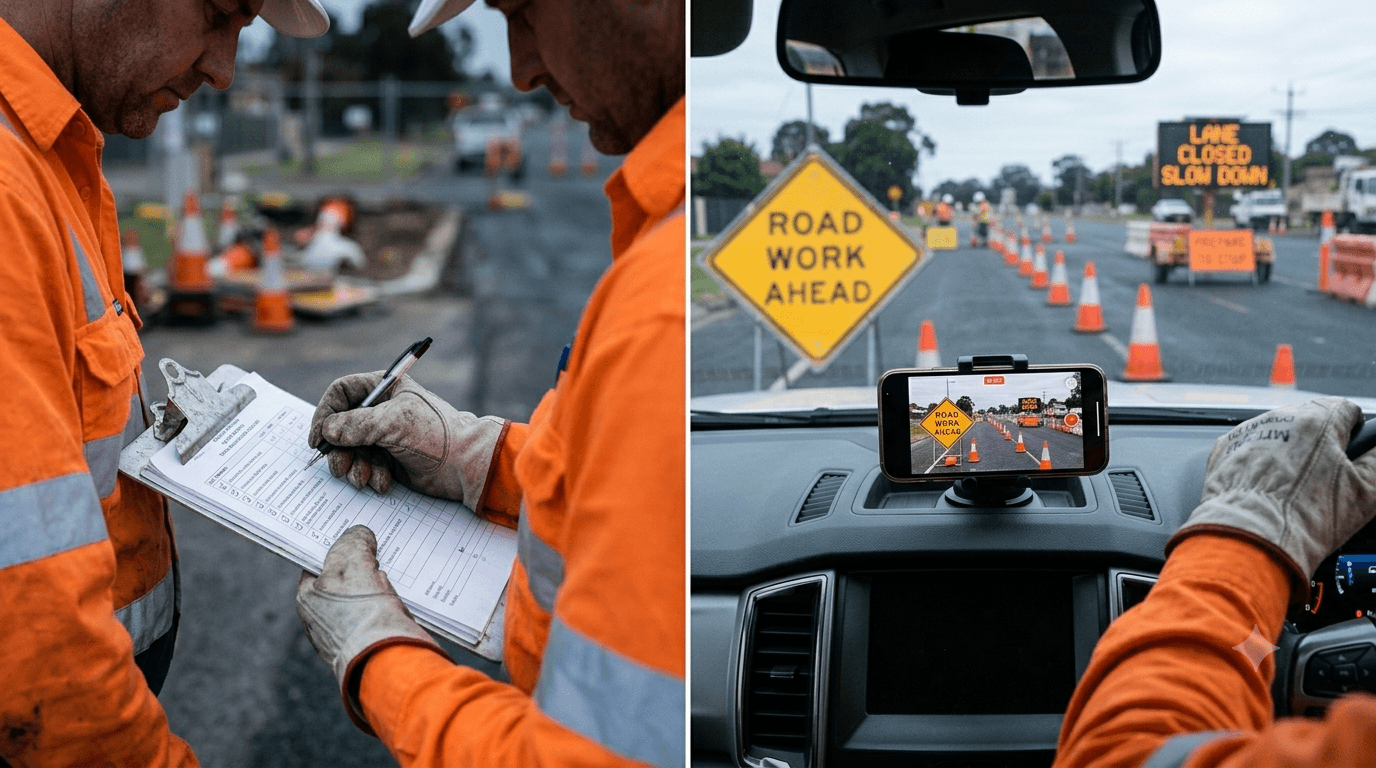
Crew B's leader follows the capture standard. She records a drive-through video of the completed setup, capturing every sign, device, and lane configuration in sequence. She photographs the TGS posted on site alongside the actual layout. When a delivery truck blocks a lane for 12 minutes, she records the deviation, the time, and the corrective action taken. End-of-shift documentation takes three minutes using a standardised video documentation workflow.
The Audit
Three months later, a road authority auditor reviews both crews' records for that week. Crew A's records show minimal evidence. The auditor cannot verify TGS compliance, cannot confirm sign placements, and has no record of deviations. Crew B's records tell a complete story: setup verified, deviation documented, corrective action recorded. The auditor flags Crew A's records as non-compliant. The company's reputation with that road authority takes a hit.
Same company. Same contract. Same intersection. Completely different audit outcomes. The only variable? Whether a capture standard existed and crews followed it.
Common Mistakes and Pitfalls
Treating documentation as a training problem. If you've trained crews three times and they still document inconsistently, the problem is the system, not the training. Stop retraining and start redesigning.
Over-engineering the standard. No crew will follow a 15-page documentation protocol in the field. If the standard can't be summarised on a laminated card that fits in a crew leader's pocket, it's too complex.
Standardising the tool before standardising the process. After all, buying software before defining what needs to be captured is like buying a filing cabinet before deciding what goes in it. Define the standard first. Choose tools that serve it.
Ignoring crew leader input. The people who will execute the standard every day know more about field constraints than anyone in the office. Build the standard with them, not for them.
Declaring victory too early. Consistency in month one does not guarantee consistency in month six. Without ongoing verification, documentation drift will return. It always does.
What to Do Next
Start with Step 1. Collect 30 days of actual documentation from every crew. Don't filter, don't judge, just gather. Build the matrix. See where the inconsistencies are. That exercise alone will clarify the scale of the problem and give you the evidence you need to justify the standardisation effort to your team and your leadership.
Even so, you don't need to overhaul everything at once. Pick the two or three most critical documentation elements (typically TGS implementation evidence and deviation records) and standardise those first. Expand from there. Incremental progress, sustained over time, beats ambitious programs that stall after launch.
Return to this guide as a reference when you move between phases. We designed the framework for revisiting, not for completing once and filing away. Your capture standard will evolve, and that's exactly how it should work.
Frequently Asked Questions
Why is standardisation important in construction documentation?
When documentation varies across crews, audits become unreliable. An auditor can't distinguish between a crew that failed to comply and one that simply failed to record compliance. Standardisation ensures every crew produces comparable evidence, making audits accurate and defensible. It also reduces the time operations leaders spend reconciling different formats and filling gaps before reviews.
What challenges do organisations face when adopting new standardisation practices in construction?
The biggest challenge is not technical — it's behavioural. Crews build habits over years. A memo won't change them. Common obstacles: standards too complex for the field, no crew leader buy-in, skipping the pilot phase, and dropping enforcement after launch. Fix these by treating standardisation as a system redesign, not a training exercise.
How can organisations ensure compliance with evolving construction industry standards?
Build a quarterly review cycle into your documentation standard. Monitor regulatory updates from state road authorities, WHS regulators, and industry bodies like Austroads and TMAA. When requirements change, update the capture standard, communicate the change to crews, and verify adoption through your existing review cadence. A living standard adapts; a static one becomes obsolete.
What should a minimum capture standard include for traffic management crews?
At minimum: pre-start meeting, evidence of TGS implementation (photos or video showing sign and device placements), any deviations from the plan with timestamps and corrective actions, incident or near-miss records, and end-of-shift site status. The specific requirements will vary by state regulation and principal contractor expectations, but these five elements form the baseline for most Australian traffic management operations.
Is video documentation better than photos for compliance evidence?
Video captures layout, sequence, and context that photos miss. A drive-through video of a completed setup shows how signs relate to each other, to the lanes, and to the surroundings in ways single photos can't. Video is especially useful for TGS compliance checks. That said, the best format is the one crews will consistently use. A standardised photo protocol executed reliably is better than a video protocol that gets skipped.
How long does it take to achieve consistent documentation across all crews?
Most operations can reach 80% consistency within 30 days of rollout and 90% within 60 days, provided the capture standard was piloted and refined before full deployment. Sustaining that level requires ongoing review and enforcement. Without active maintenance, documentation drift typically re-emerges within three to six months.
Sources
https://globallawexperts.com/building-law-reforms-australia/
https://cmicglobal.com/resources/article/What-is-Regulatory-Compliance-in-Construction
https://www.sitestory.app/blog/what-clients-really-want-from-their-traffic-management-partners
https://www.sitestory.app/blog/the-role-of-video-documentation-in-reducing-legal-liability
More post you may like

Video Documentation
Thought leadership
Video Evidence for Disputes: What You Can Prove
20 Sept 2026
·
Adam Ricketts

Thought leadership
Video Documentation
Construction Compliance Documents for Fast-Changing Sites
16 July 2026
·
Adam Ricketts

Industry Insights
Video Documentation
Reduce Rework in Construction: Blame the Gap, Not the Crew
1 July 2026
·
Adam Ricketts

Thought leadership
7 Construction Productivity Improvement Fixes for Traffic Crews
22 May 2026
·
Adam Ricketts

The purpose-built video documentation platform for traffic management and construction. One tap. Organised automatically. Ready when you need it most.


