
Go Back
Video Evidence for Disputes: What You Can Prove
Discover why traditional construction documentation fails under scrutiny and how video evidence for disputes closes the gap between compliance intent and ver...


Why traffic management documentation fails under scrutiny — and what verifiable records actually look like
Explore the gap between what traffic management crews believe they've documented and what holds up during a DOT audit, incident investigation, or client dispute. Learn why traditional photos and checklists fall short and how timestamped video evidence closes the liability gap.
TL;DR
Compliance isn't the same as verifiability - Most traffic management teams document their setups, but few produce records that would survive a DOT audit, legal dispute, or insurance investigation.
Video beats photos for evidence - Continuous, timestamped video provides sequenced, contextual proof of site conditions that isolated photos and checklists simply cannot match.
Adoption depends on simplicity, not training - Crews won't consistently use documentation tools that add friction. The process must disappear into existing workflows like post-setup walkthroughs.
Think liability instrument, not compliance task - Treat every record as something that might end up in front of an auditor or adjuster, and the quality of your documentation transforms overnight.
The Setup Was Right. The Proof Was Gone.
Every traffic management crew we've ever talked to wants to believe they're compliant. They set up the signs. They place the cones. They follow the traffic management plan and TGS. And they're almost certainly telling the truth.
But here's the friction: when a DOT audit lands, when an incident triggers an investigation, or when a client disputes your setup, nobody asks what you did. They ask what you can prove. And for most crews, the gap between those two questions is where the liability lives. Construction documentation isn't about what happened. It's about what survives scrutiny.
The Compliance Illusion: "We Documented Everything"
The industry built its standard approach to traffic control documentation on good intentions. Crews snap a handful of photos at setup. They fill out a daily diary with a checklist that gets signed off. On paper, it looks thorough.
And for years, it was enough. Auditors accepted it. Clients didn't push back. The system worked because nobody rarely tested it.
But the landscape has shifted. Disputes are more frequent. Litigation is more aggressive. And the standard of evidence has risen dramatically. A photo of a sign doesn't prove someone placed it in the right position at the right time. A checklist doesn't prove the delineation matched the plan. What used to pass as documentation now functions more like decoration: it looks like proof until someone actually needs it to be proof.
The Real Question Isn't Compliance. It's Verifiability.
Here's what we actually believe: the distinction that matters in traffic management documentation isn't between "compliant" and "non-compliant." It's between "documented" and "verifiable." A verifiable record is sequenced, timestamped, and shows context. Everything else is just a story you're hoping nobody challenges.
What Holds Up and What Falls Apart
Consider a common scenario. A lane closure on a state highway. The crew sets up according to the traffic management plan. Two hours later, a vehicle enters the taper and clips a worker's truck. No injuries, thankfully. But the investigation begins.
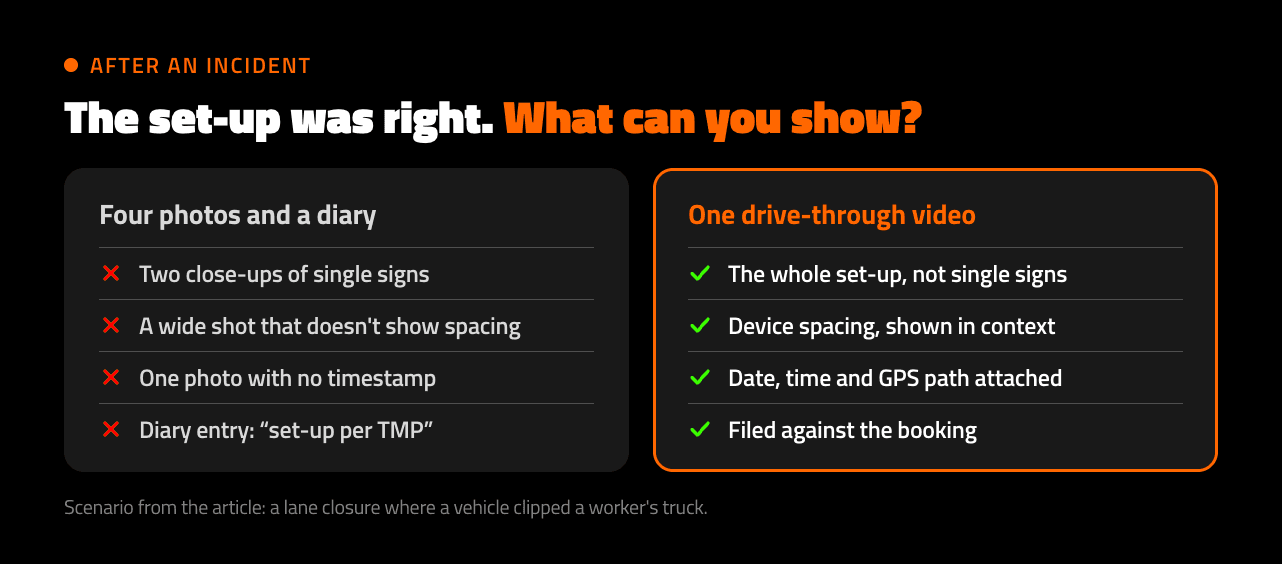
The DOT wants to know: Did crews place the advance warning signs at the correct distances? Was the taper length compliant? Did they space the delineation devices properly? The crew says yes. The crew is probably right. But what can they show?
Four photos. Two of them are close-ups of individual signs. One is a wide shot that doesn't clearly show spacing. The fourth has no timestamp metadata because someone turned the phone's location services off. The daily dairy says "setup per TMP." That's it.
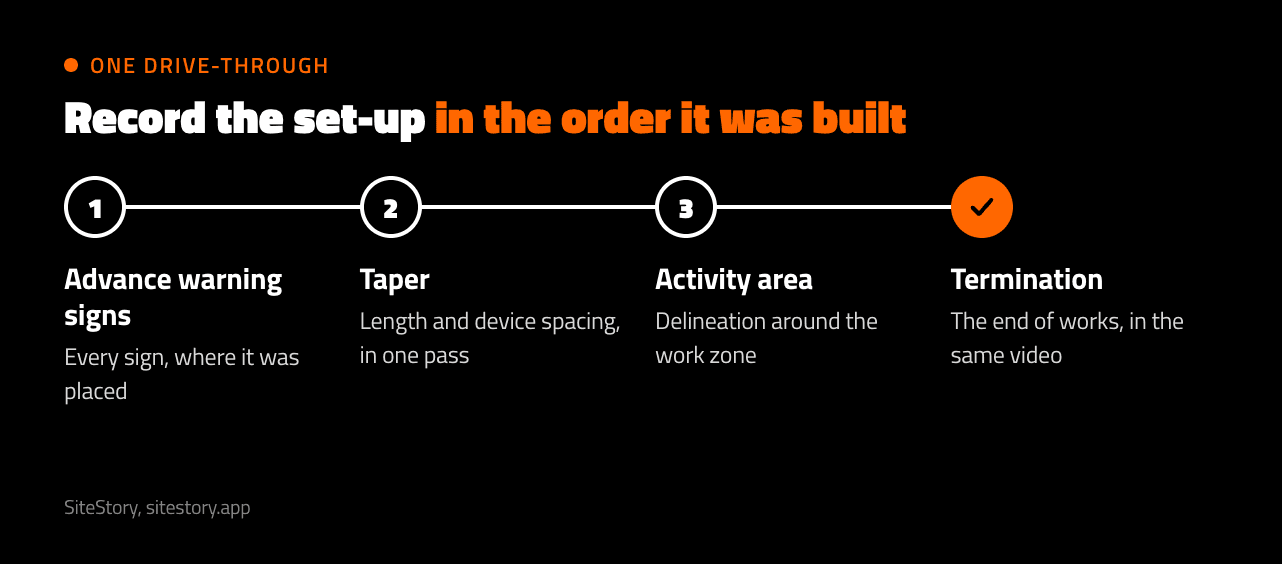
Now compare that to a crew that drove the setup with a phone, recording a continuous video from the first advance warning sign through the taper, the activity area, and the termination. Sixty seconds of footage. Timestamped. Geotagged. Showing every device in sequence, in context, exactly as placed.
As legal analysis from Best Practices Construction Law puts it, photo and video evidence often carry more weight than competing recollections or even written documentation when conflicts escalate. Visual records have become the "gold standard of proof." That phrase isn't aspirational. It describes how adjudicators already decide disputes.
The difference between those two crews isn't effort. It's not even time. It's the shape of the evidence. One crew has fragments. The other has a narrative. And timestamped footage delivers clear proof of compliance status, material conditions, and responsibility in ways that static images simply cannot.
This is where the adoption problem lives. We've seen it repeatedly: the barrier to better site condition recording isn't technology resistance. It's process friction. Crews don't refuse to document. They refuse to do something that feels like extra work bolted onto an already demanding job. The tool that wins isn't the most powerful one. It's the one that disappears into the workflow.
That's the design philosophy behind SiteStory, which reduces video documentation to a single tap during the post-setup drive-through crews are already doing. No uploads to manage. No folders to organise. No second app to open. The documentation happens inside the inspection, not after it.
But the principle holds regardless of what tool you use: if the documentation process adds more than 2 minutes to a crew's routine, it won't happen consistently. And inconsistent documentation is almost worse than none, because it creates the impression of a system without delivering the protection of one.
The Cost of the Gap You Can't See
If this framing is right, the implications are uncomfortable. It means that most traffic management companies currently operate with a false sense of security. They believe their documentation process protects them. But that process produces evidence that wouldn't survive a serious challenge.
The cost isn't theoretical. A single disputed incident without verifiable records can mean absorbing liability for damages you didn't cause. It can mean failing an audit that triggers increased oversight, or losing a contract because a client can't trust your compliance trail. As Roberts Litigation guidance on construction disputes emphasises, meticulous records including photos, daily reports, and sequenced documentation create a factual timeline that is invaluable in resolution. Without that timeline, you're negotiating from weakness.
The question for every operations leader is simple: if your worst day happened tomorrow, would your records tell the full story? Or would they leave gaps that someone else fills with their version?
Rethinking Documentation as a Liability Instrument
The mental model shift is this: stop treating documentation as a compliance task and start building it as a liability instrument. A compliance task is something you do to satisfy a requirement. A liability instrument is something you build to protect your position when things go wrong.
Compliance tasks get shortcuts. They get "good enough." They get done by whoever has a free hand. Liability instruments get treated with the seriousness of something that might end up in front of a judge, an auditor, or an insurance adjuster. Because they might.
When you make that shift, the conversation changes. You stop asking "did we document?" and start asking "would this hold up?" That single question, applied consistently, transforms video evidence from a nice-to-have into an operational standard.
Your Crews Already Know the Setup Was Right
The irony of traffic management documentation is that the people who think they need it least are the ones who have to create it. Your crews know the setup was compliant. They were standing right there, but having the right visual evidence will protect them in the future.
The documentation isn't necessarily for now. It's for the version of the future where someone who wasn't there needs to know exactly what happened. Build your records for that person. Because when they show up, they won't ask what you intended. They'll ask what you can show them. It will protect you and your crew long into the future.
Frequently Asked Questions
What is video documentation in construction and traffic management?
Video documentation is the practice of capturing continuous, timestamped video of site conditions, setups, and work progress. Unlike individual photos, it provides sequenced, contextual evidence that shows how a site looked at a specific moment in time.
Why is video evidence for disputes more effective than photos alone?
Photos show isolated moments without sequence or spatial context, making them easy to challenge. Video captures the full picture (device spacing, sign placement, site conditions) in a continuous record that's far harder to dispute and eliminates the hidden time costs of organising and searching fragmented photo libraries.
How can crews adopt site condition recording without slowing down?
The key is embedding documentation into workflows that already exist, like post-setup inspections. Tools that reduce capture to a single action (rather than requiring separate apps, uploads, or file management) see dramatically higher adoption because they don't feel like extra work.
Sources
https://www.bestpracticesconstructionlaw.com/2025/09/articles/best-practices/video-toolbox/
https://www.spot.ai/blog/video-evidence-construction-margins-chargebacks
https://www.robertslitigation.com.au/post/construction-dispute-resolution
https://sitestory.app/blog/why-video-evidence-is-becoming-the-new-standard-in-site-compliance
https://www.sitestory.app/blog/the-hidden-time-cost-of-photo-documentation
More post you may like

Thought leadership
Video Documentation
Construction Compliance Documents for Fast-Changing Sites
16 July 2026
·
Adam Ricketts

Industry Insights
Video Documentation
Regulatory Compliance in Construction: A Crew Documentation Guide
8 July 2026
·
Adam Ricketts

Industry Insights
Video Documentation
Reduce Rework in Construction: Blame the Gap, Not the Crew
1 July 2026
·
Adam Ricketts
Thought leadership
7 Construction Productivity Improvement Fixes for Traffic Crews
22 May 2026
·
Adam Ricketts

The purpose-built video documentation platform for traffic management and construction. One tap. Organised automatically. Ready when you need it most.


